
After much reflection, I’ve realized it’ll be simplest to have no manual adjustment mechanism. Adjustment will be accomplished by unscrewing the front bezel and toggling the month and day levers directly with a poker. The irony of insisting on simplicity in a perpetual calendar watch is not lost on me. But really, it makes sense: I’m aiming for the cleanest, simplest mechanism which will show the correct day and date until 2100. (The mechanism will require a correction then because it ignores that the Gregorian Calendar skips February 29 on years divisible by 100 but not those divisible by 400.) In the spirit of simplicity, there will be no seconds display, nor will there be any display for the day of the week.
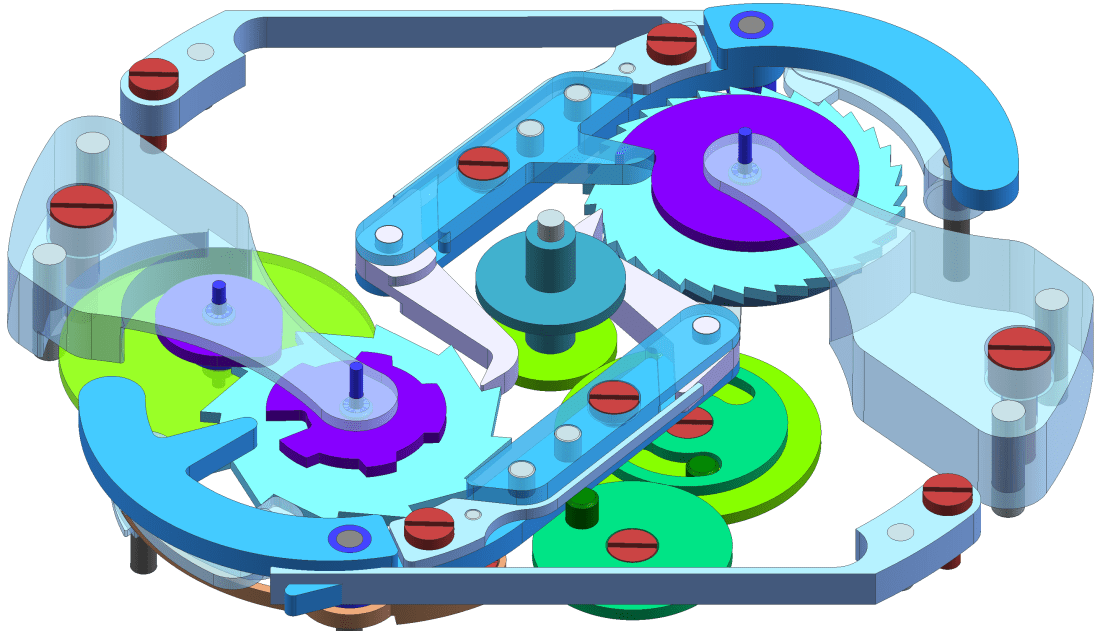
Forgoing a manual adjustment mechanism means that the broad strokes of the design are done. The next step is to release parts at 5x scale to a 3D printer. This is a cheap way to validate the kinematics, and enable corrections and refinement before the substantial effort of making parts at scale. Here’s the current mechanism:
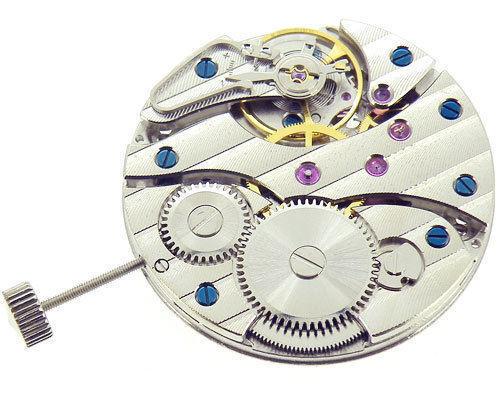
I’ve decided to use a basic Seagull movement ($40 time only) as the foundation for the calendar work. If the biggest problems with Seagull movements are that parts sometimes have burrs and that the movements come without oil, I think I’ll be fine. More than anything else, the foundation movement needs to be simple and hearty, and easy to purchase.
machinery as art
The purpose of this whole endeavor is to make something beautiful- machinery as art. I reflected on this after seeing the following painting earlier today at the de Young Museum in San Francisco. Watch, 1925 by Gerald Murphy.
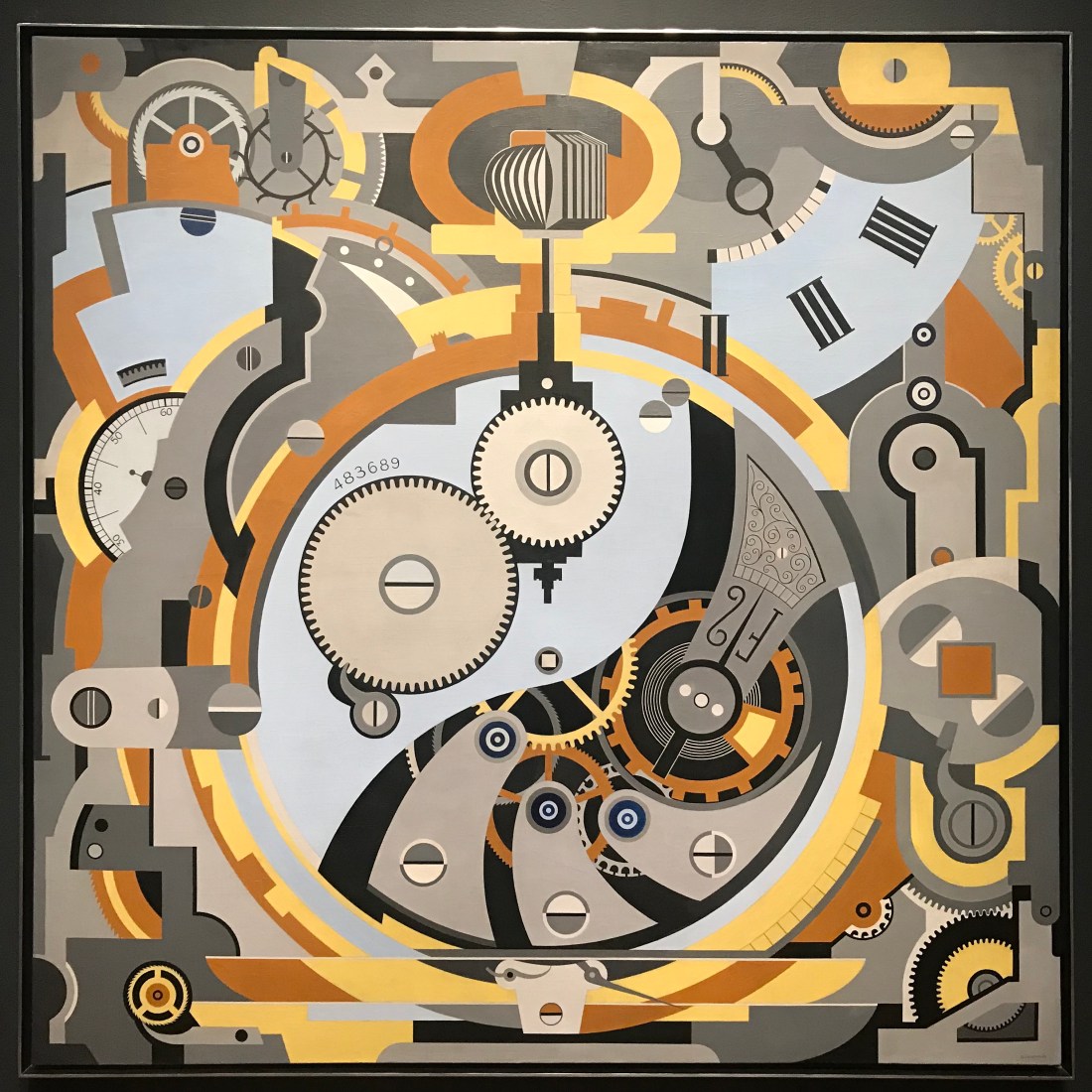
This is a large oil on canvas, about 5 feet square. It’s a striking piece that everyone stopped to consider. I would describe it as machinery in art, rather than as art.
Machinery in art is where you paint a picture of a watch. Machinery as art is where you build a watch.
The placard next to the painting said the watch “features a broken mainspring”. If anyone sees a broken mainspring in this painting, please let me know. I see questionable gears and something inspired by a cylinder escape wheel, however there isn’t any mainspring that I can see, broken or otherwise.
 Making A Perpetual Calendar Watch